MTG: The M6 Mac mini Is Coming — So What Happens to the M4?

Apple has announced a new Mac mini with the M6 chip.
Pre-orders opened on 25 August 2026. Availability begins on 22 September. In the UK, the base model costs £899.
That gets you an M6 with a 12-core CPU, 12-core GPU, 16GB of unified memory and a 256GB SSD.
Which is all very interesting. But More Than Gadgets is not only interested in the shiny new thing. The more useful question is this:
What does the M6 launch do to the value of the M4 Mac mini?
Because the M4 has recently become rather awkward to find. And whenever something becomes hard to find, people start adding optimistic numbers to online listings. Sometimes the market is genuinely tight. Sometimes the seller has simply discovered the word “rare”.
Let’s look at what is actually known, what Apple is claiming, and where a sensible buyer should put their money.
MTG: The M6 Mac mini in plain English
The new M6 Mac mini keeps the compact desktop design introduced with the previous generation. It is still the small silver box that sits quietly on a desk and does not demand the visual attention of a gaming PC.
Apple says the M6 brings:
- A 12-core CPU
- A 12-core GPU
- Neural Accelerators
- A Dual 16-core Neural Engine
- 16GB unified memory as standard
- 256GB SSD storage as standard
- Wi-Fi 7
- Bluetooth 6
- 2.5Gb Ethernet
- Support for up to three external displays
There is also an optional 10Gb Ethernet upgrade, and the M6 model has three Thunderbolt 4 ports, HDMI, two front USB-C ports and a headphone jack.
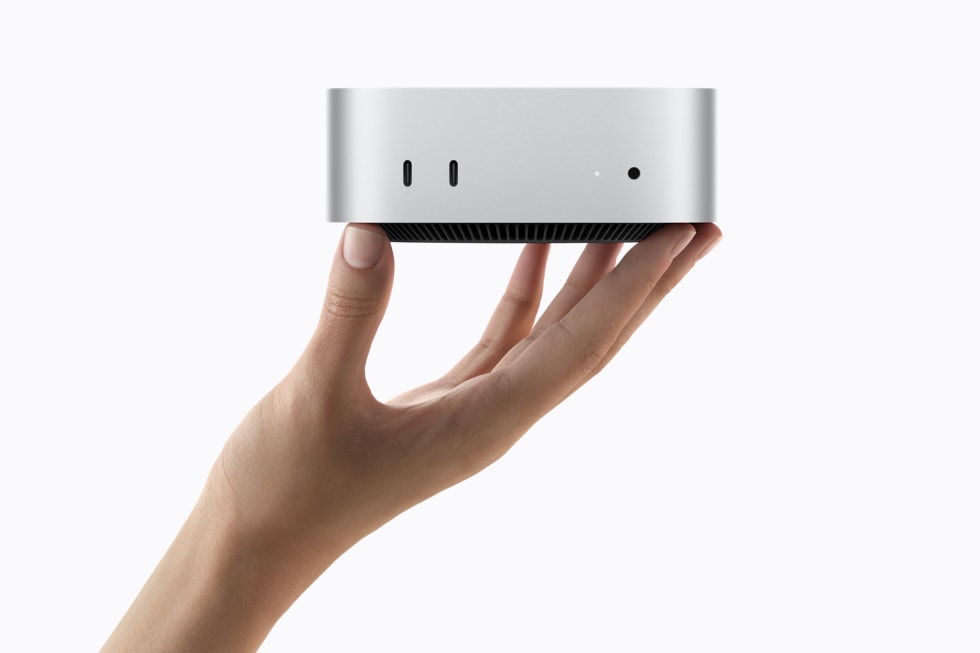
Apple’s headline claims are substantial. It says the M6 Mac mini offers up to four times faster AI performance, twice as fast graphics and storage, and 40 per cent faster CPU performance compared with the previous generation.
But those are Apple’s claims, based on Apple’s testing. They are not independent MTG test results, and we have not been using an M6 Mac mini for long-term hands-on work.
That distinction matters. A manufacturer’s comparison is useful for understanding what it believes has improved. It is not the same as testing the machine with your own applications, files and irritating little workflow habits.
MTG: Why the M6 is so focused on AI
The main story here is not simply “new chip faster”.
It is on-device AI.
Apple says the M6’s GPU includes Neural Accelerators in each core, alongside its updated Neural Engine. The company is positioning the Mac mini as a machine for running local AI models, AI agents and other workloads without sending everything to a remote data centre.
That is part of the reason the M4 Mac mini became unexpectedly interesting.
According to reporting from The Verge, demand for the previous Mac mini was helped by people buying compact Macs to run AI agents and local models. That demand contributed to reported scarcity around M4 units.
It does not mean every used M4 Mac mini is suddenly selling above its original retail price. It does not mean every listing is a bargain either. It means supply, configuration and demand have become tangled together.
And AI demand can make that worse. Someone looking for an M4 with more memory may not be comparing it with a basic office computer. They may be looking for a relatively affordable local compute box that can sit in a corner and work all day.
That is a different buyer from someone who wants to browse the web, edit documents and watch videos.
MTG: What normally happens to second-hand prices?
Normally, a new generation takes some heat out of the used market.
More new stock appears. Buyers get a fresh reference point. Sellers who were asking enthusiastic prices have to explain why their used machine costs nearly as much as a newer one.
The M6 starts at £899 in the UK, so that is the number any M4 buyer should have in mind. Not because every M4 should be compared with the base M6 in a simplistic way, but because it is the current new entry point.
The market may still be uneven for a while.
A used M4 with 24GB or 32GB of memory could remain attractive to somebody who needs more headroom than the base M6 provides. A machine with 512GB or 1TB of storage may also be worth more than the basic 256GB model. A seller offering a clean unit with proof of purchase and remaining warranty has something different from somebody selling a scuffed computer with no accessories and an optimistic description.
Then there is availability. The M6 has been announced, but availability does not begin until 22 September. There may be a period where demand for the new model is high but actual stock is still moving through the system.
So, yes, the M6 should generally put downward pressure on M4 prices.
No, it does not guarantee a sudden collapse in every M4 listing.
This is a market, not a carefully calibrated experiment conducted in a glass box.
MTG: The M4 is not suddenly useless
The arrival of the M6 does not make the M4 a bad computer.
For normal desktop work, the M4 Mac mini remains capable. Email, documents, spreadsheets, web work, coding, photo management, light video editing and general home use are not going to stop functioning because Apple has printed a new number on a chip.
The M6-specific improvements matter most when you will actually use them.
That could include:
- Running local AI models
- Building or using on-device AI agents
- Working with demanding creative applications
- Using faster storage regularly
- Driving several high-resolution displays
- Needing newer wireless and network standards
- Keeping the machine busy for long periods
If none of that describes your work, an M4 at the right price could still be the more sensible purchase.
That last part is important: at the right price.
The question is not whether the M4 is good. The question is whether the particular M4 in front of you is good value compared with a new M6, including the warranty and the cost of finishing your desk setup.

MTG: What does “good value” look like?
Current UK refurbished listings give us some useful context, although prices and stock move around.
At the time of checking, refurbished M2 Mac mini examples were appearing around £429 to £499, with one marketplace example around £484 on Back Market’s UK Mac mini listings.
That is not an M4 price guide, and it should not be treated as one. It does show the broader shape of the market: older Apple silicon Mac minis can make sense when the discount is meaningful.
For an M4, compare the real price against £899 rather than accepting a seller’s “rare because discontinued” argument. Check:
- The exact chip and configuration
- Memory capacity
- SSD capacity
- Physical condition
- Remaining warranty or consumer protection
- Whether the power lead is included
- Return rights
- Whether the seller has supplied a proper serial number and purchase details
A lightly used M4 with more memory at a sensible discount may be attractive. An M4 with 16GB and 256GB storage priced close to £899 is a different conversation.
MTG: Do not forget the rest of the desk
The £899 M6 price is for the Mac mini itself.
Apple’s box contains the computer and a power lead. It does not include a display, keyboard or mouse.
That means the real cost of moving to a Mac mini may include:
- A monitor
- Keyboard
- Mouse or trackpad
- USB-C hub or dock
- External storage
- Ethernet equipment
- Display cables
The small box is not the whole desk. It is the bit that makes the rest of the desk do something.
If you already have a suitable display, keyboard and mouse, that may not matter. If you are starting from nothing, add those costs before deciding whether £899 is affordable.
MTG: A practical M4 or M6 buying checklist
Before buying either generation, answer these questions.
MTG: 1. What will you actually use it for?
Office work and general home use do not automatically require the newest chip. Local AI, creative work and sustained workloads may justify the M6.
MTG: 2. How much memory do you need?
Unified memory is shared across the processor, graphics and other workloads. It is not generally something you upgrade later, so buy enough at the start.
The base M6 has 16GB. Higher configurations are available. A well-priced M4 with 24GB or 32GB may be more useful for your work than a basic M6.
MTG: 3. Is 256GB enough?
It might be, if most files live elsewhere. It may become irritating quickly if you store photos, video, applications or local AI models on the internal drive.
Storage upgrades are expensive. External storage can help, but it adds another box, cable and point of failure.
MTG: 4. What warranty and condition are you getting?
A lower price is less exciting if the machine arrives with damage, a tired port or no meaningful return option. Refurbished does not mean identical across every seller.
MTG: 5. What ports and displays do you need?
The M6 supports up to three external displays, according to Apple’s UK specifications. Check the exact resolution and refresh-rate combination you need rather than stopping at the headline number.
Also check your cables, docks and monitors. “It has HDMI” is not a complete technical plan.
MTG: 6. Do you genuinely need local AI?
If you are buying specifically for local models or AI agents, memory, storage and software support matter as much as the chip badge. Do not assume that buying M6 automatically solves every local AI requirement.
MTG: So, should you buy the M6 or wait for a cheaper M4?
If you need a Mac now and your work benefits from the M6’s newer AI and connectivity features, the £899 model is the straightforward choice. You can read Apple’s official announcement and check the UK buy page for the current configuration and availability.
If you are considering an M4, wait for the M6 to become properly available and watch how used prices respond. Do not chase a scarce listing simply because other people are chasing it.
The MTG position is fairly simple: useful reviews, an honest look at how far technology has come, and a proper question about how cheaply you can do the job.
Replace the computer when it breaks, when it no longer meets your needs, or when the numbers genuinely work.
Not merely because a new badge has arrived.
For more practical technology commentary, visit the aelhawley blog.
if anything I've said today struck a chord with you and you'd like a chat or if you have a particular challenge with energy, power & infrastructure, business generally or you might like to use the studio, drop me an email at andrew@aelhawley.com - if you've watched the video version of this blog you can drop a comment below and, I think I'm supposed to say like and subscribe but I won't. See you on Sunday in the field.. that to be clear, isnt my garden.