MTG: What's Next — Can One Device Really Replace Three?
There’s been a slight change of direction at MGT / More Than Gadgets.
What began as a collection of free-form videos, including the occasional walk around a field that definitely isn’t Andrew’s garden, has started moving towards something rather more useful: practical technology reviews.
Not reviews written from a press release. Not a table of specifications read out in a serious voice. Real-world testing, with the important question asked at the end:
Is this actually good value, or have we simply found another expensive way to check the weather?
You can watch the full video here:
MTG: From field videos to tech reviews
Andrew explains in the video that the channel has spent the past few weeks focusing more heavily on technology reviews.
The MacBook Neo video helped set that direction. There have also been videos about Surface laptops, the possibility of moving from iOS to Android, and several shorter videos.
That seems to have worked. The channel has moved from roughly 100 subscribers to about 110, according to Andrew’s estimate in the video.
That is not exactly the sort of growth that will have YouTube executives arriving by helicopter. But it is progress, and it has happened without a carefully engineered growth plan. The videos were being made because they were enjoyable, and because there was something worth testing.
There is, however, a slightly less relaxed reason for encouraging people to subscribe.
MTG: A note on YouTube monetisation
Andrew talks about YouTube’s monetisation requirements as he understands them. His understanding is that the channel needs to reach a particular level of watch time: he refers to 4,000 hours within a set period, understood to be 12 months. He also says that if the target is not reached by February, the requirement may become 8,000 hours.
Those figures are included here as Andrew’s understanding from the video, not as independently verified YouTube policy. Rules and eligibility requirements can change, and anyone relying on them should check YouTube’s current official guidance.
The important point is that the channel will continue either way. Reaching the target sooner would simply help move things along.
So, if you enjoy the videos, subscribing would be useful. It costs nothing, and it helps a small channel establish whether this technology-testing lark has legs.
MTG: The six-use-case question
The next major experiment centres on two devices:
- A Samsung Galaxy Z Fold 8
- A Microsoft Surface Pro
These are not completed review results. They are the proposed basis for an upcoming test.
The question is whether two pieces of hardware could realistically cover the work of six separate device roles.
The Z Fold 8 could potentially act as:
- A normal smartphone
- An iPad-type device when opened
- A desktop computer when connected to a larger display using Samsung DeX
The Surface Pro could potentially act as:
- A tablet
- A laptop when used with its keyboard
- A desktop computer when connected to a larger monitor
That is where the “one plus one equals six” idea comes from.
It is not mathematical fraud. It is a question of use cases. Two physical devices might provide six different ways of working, depending on how they are configured.
Samsung describes DeX as a desktop-like experience that can run from selected Galaxy devices, with support for external displays and multiple windows. That does not automatically make a phone a full replacement for a desktop computer. It does, however, make the question worth testing.
The distinction matters. A device can technically display apps on a large screen without being pleasant to use as a desktop. There is a difference between “it works” and “I would willingly use it every day”.
That is exactly what the test needs to establish.
MTG: The value-for-money calculation
MGT is not only interested in what is new or what has the longest list of features.
The more useful question is usually: what do I get for the money?
The Z Fold 8 and Surface Pro are both being considered because they may offer more than one form factor. A phone that becomes a larger tablet has one advantage. A phone that can also provide a desktop-style environment has another.
The Surface Pro follows a similar principle. It is a tablet until a keyboard is attached, and potentially a desktop system when connected to a larger screen.
Whether that represents genuine value will depend on several things:
- How often each mode is actually used
- Whether the software behaves properly in each mode
- Whether keyboards, docks and monitors add too much extra cost
- Whether files, messages and apps move smoothly between devices
- Whether the compromises become irritating after the novelty wears off
Six theoretical use cases are interesting. Six useful use cases would be better.
The planned experiment should help separate the two.
MTG: The iMessage problem refuses to go away
Every time Andrew considers moving away from Apple, the same obstacle appears: iMessage.
This is not because he is particularly concerned about blue and green bubbles. As he says in the video, he does not care about that part.
The difficulty is that messaging between iMessage and SMS can be awkward. Messages do not always move across as neatly as they should, even when iMessage has been switched off. It becomes one of those small technical problems that is not dramatic, but is just irritating enough to influence a much larger buying decision.
The possible solution is an app called BlueBubbles.
BlueBubbles describes itself as bringing iMessage to Android, Windows and Linux. The approach involves using a Mac as a server, with the Mac handling iMessage and passing messages through to other devices.
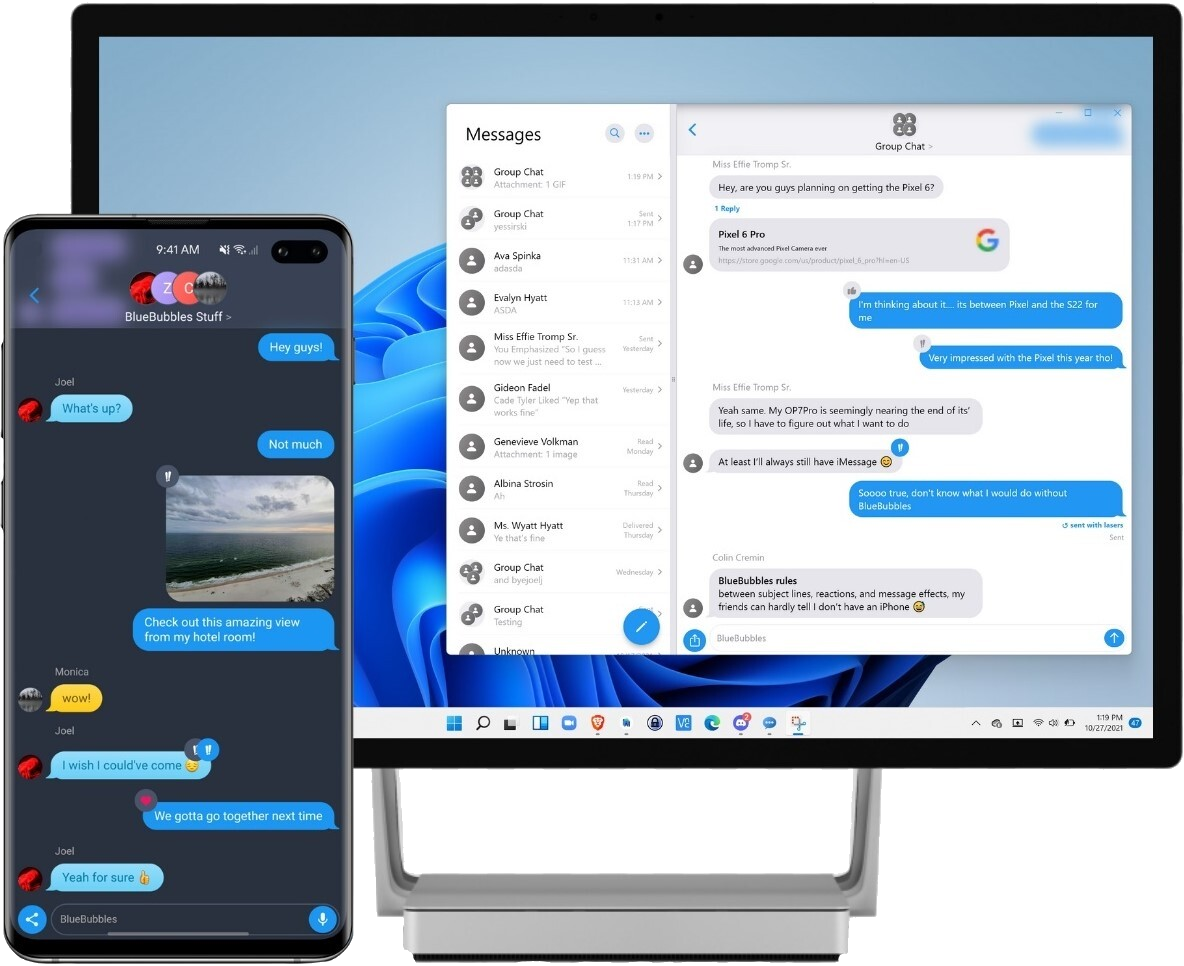
That means moving away from the iPhone might not necessarily mean abandoning iMessage altogether. It could mean keeping a Mac: or perhaps an older Mac mini: running in the background as the server.
That is still a compromise. A server is another device to maintain, power and occasionally wonder about when it stops responding. But it may be less disruptive than changing every contact, habit and family group chat simply to use a different phone.
Andrew is curious to see whether BlueBubbles is a workable solution in everyday use. That is a practical test, not a promise that the problem has already been solved.
MTG: What happened to the MacBook Neo?
The MacBook Neo remains one of Andrew’s favourite Apple devices. In the video, he describes it as one of Apple’s best devices in some considerable time, alongside the Mac mini.
Unfortunately, he has stopped using it.
The reason is straightforward: the screen is too small for his eyesight.
There is nothing wrong with the screen itself. The issue is personal. Andrew finds it difficult to see comfortably, so he has moved to a 15-inch MacBook Air instead.
That is an important distinction in any technology review. A product can be excellent and still be the wrong product for a particular person.
The MacBook Air keeps some of the thinness and portability that appealed to him about the Neo, without moving all the way up to a MacBook Pro. Andrew also says the MacBook Pro has become uncomfortably expensive, including on the second-hand market.
No universal conclusion follows from that. The MacBook Neo has not suddenly become a bad computer. It simply no longer suits Andrew’s eyesight.
A proper MGT review should include that sort of reality. Specifications do not tell you whether you can comfortably read a screen after an hour of work.
MTG: What about Apple’s possible foldable?
The video also looks ahead to a possible Apple foldable device, sometimes described in the discussion as an iPhone Fold or iPhone Ultra.
This is clearly presented as expectation and speculation, not confirmed fact. No product, specification, price or launch date should be treated as established here.
Andrew’s concern is that a future Apple foldable might offer two useful roles: a phone and an iPad-type screen: but fail to provide the third role.
That third role would be a proper desktop experience when connected to a large display.
Apple’s Stage Manager is intended to help iPad users work with multiple windows and external displays. Andrew’s personal experience and view, as expressed in the video, is that it does not yet deliver what he would regard as a true desktop replacement.
That is the test Apple would need to pass. A very expensive folding iPhone may be impressive as a phone and useful as a small tablet. But if it cannot become a convincing desktop, then it may not match the three-role argument being made for the Z Fold 8.
The conclusion is not that Samsung has won, or that Apple cannot solve it. It is simply that the third use case matters.
MTG: Wednesday is becoming the tech-review slot
The next technology review is planned for Wednesday evening, continuing the move from iOS towards Android.
The Z Fold 8 will be central to that review, and the Surface Pro may be included if the timing works. The tests will look at whether the two devices can work together, whether the proposed six-use-case idea holds up, and whether it is possible to move away from iOS without losing too much convenience.
There may also be a few shorts filmed directly from the Z Fold 8.
The schedule is not entirely fixed. Andrew is going away for a long weekend, so there may or may not be a video next week. That is the difficulty with producing technology content from real life rather than from a content calendar carved into stone.
For now, the plan is simple:
Test the devices. Use them properly. See what breaks. Work out whether the convenience is worth the compromise.
And if it turns out that one device can replace three, that would be rather useful.
If it turns out that it can replace three devices only after buying six accessories and maintaining a Mac mini server in a cupboard, that will be useful to know as well.
That is what MGT / More Than Gadgets is trying to find out.
if anything I've said today struck a chord with you and you'd like a chat or if you have a particular challenge with energy, power & infrastructure, business generally or you might like to use the studio, drop me an email at andrew@aelhawley.com - if you've watched the video version of this blog you can drop a comment below and, I think I'm supposed to say like and subscribe but I won't. See you on Sunday in the field.. that to be clear, isnt my garden.