Square Roots: The Building Is on the Market

Square Chapel is now on the market, and that's the simple fact at the heart of this third post in the Square Roots series.
The building has been closed to the public since February 2025. It was used for green-room or production purposes during Piece Hall's summer concert activity, but it hasn't reopened as a public venue. Watling Real Estate is now marketing it, and the detail behind that sits in what follows.
What has happened
Following the winding-up order issued to Square Chapel CIC by the High Court in May 2026, and the building's placement in the custody of the Official Receiver, ACE instructed Watling Real Estate as Receiver in connection with its legal charge.
ACE says Watling's role is to act in the interest of all creditors and protect the building, over which ACE holds a legal charge. ACE has also said it remains committed to trying to return Square Chapel to cultural use for the communities of Halifax, and that it will work with Watling and local stakeholders to help facilitate that. That's the stated position from Arts Council England.
Watling is carrying out the marketing process. Its listing says simply: “We are inviting offers at this time.” There is no published guide price.
Beyond that, there isn't much point pretending to know more than has been published. There is no public information here about who might bid, what offers may or may not have been made, or what happens next. Those are matters for the process itself.
What I can say plainly is that any credible future for Square Chapel depends on four things coming together: Calderdale Council, Arts Council England, the Save Square Chapel community group and the local business community. Local businesses shouldn't be treated as a last resort or a whip-round at the end. They belong in this from the start, because they have a direct stake in a town centre that is alive, and a working venue is part of what brings people in and keeps them there.
The point of getting those four around the same problem is simple. It is to build a financially stable working model that secures the building, its future and its status as an arts centre, rather than producing a temporary rescue that feels good for five minutes and then runs into the first serious bill. This post is about the sale process, so that matters. Goodwill does not satisfy a Receiver, and sentiment does not pay for a roof.
I also don't think the ambition should stop at Halifax. Square Chapel is a Halifax building, yes, but it can also be a cultural icon for West Yorkshire rather than just a local concern parked in a local argument.
And underneath all of that is something very simple. The building was put up in 1772 for a human need that hasn't changed much: a room where people could gather, hear and take part. Whatever happens next ought to be built on those foundations rather than copied from somebody else's template.
Most of all, voices need to be heard. The people who used the building, the people who live around it, the artists, the businesses — all of them matter if this is going to have any real future. Now that the building is being marketed, that need has stopped being theoretical. That's one reason I'm setting this out publicly rather than standing on the touchline.
What is actually being marketed?
Watling’s marketing material describes Square Chapel as:
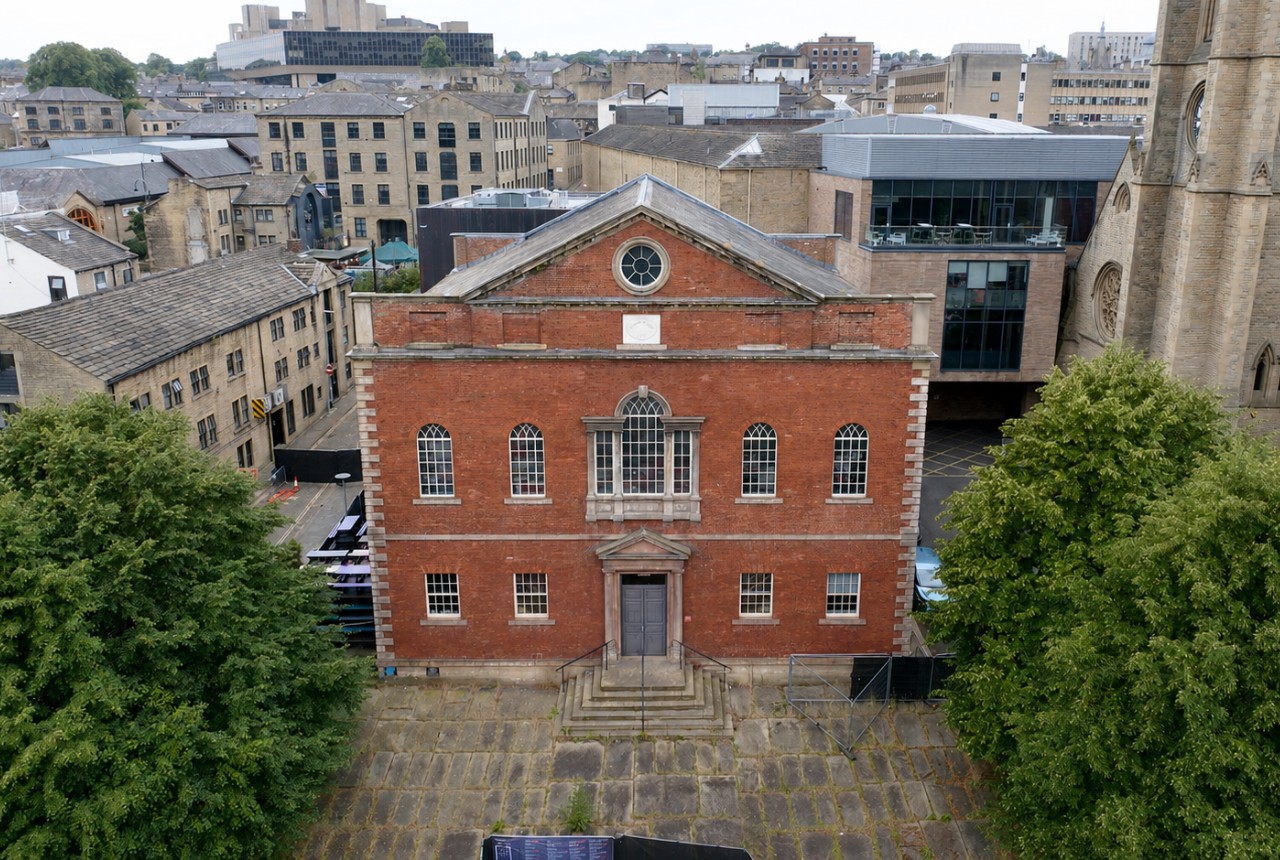
“a landmark, newly refurbished Grade II Georgian chapel and contemporary events venue”
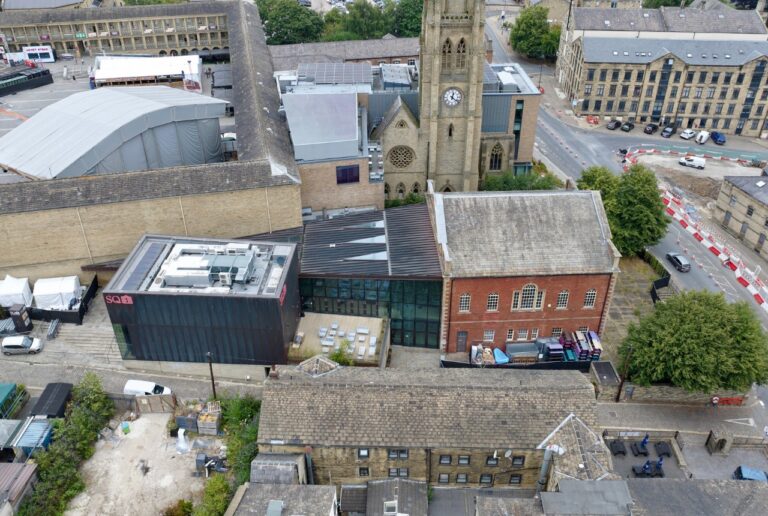
The brochure gives the building’s area as 1,780.58 square metres and describes two performance spaces capable of seating 220 and 115 people respectively. It also lists a fully equipped kitchen, a well fitted-out bar, external loading and multiple parking spaces.
The property is split into two titles. The original chapel is held freehold. The remainder is held on a long leasehold, with 116 years remaining and an expiry date of June 2142, according to Watling’s brochure. That leasehold section includes the contemporary wing, the second auditorium, the foyer, café, bar and back-of-house areas.
The brochure also gives an understood rateable value of £45,000. As ever with that sort of figure, it advises interested parties to make their own enquiries with the local authority.
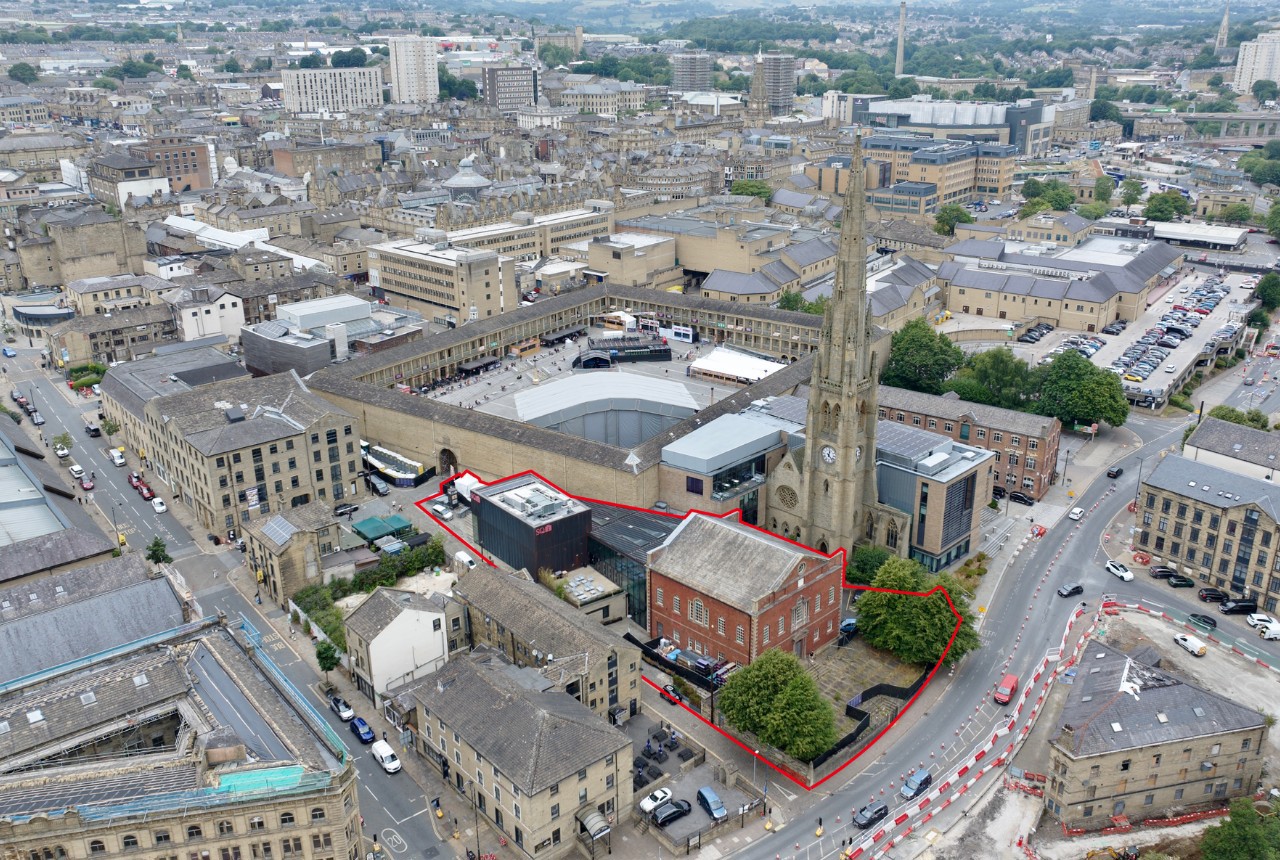
Square Chapel isn't sitting on the edge of town waiting to be discovered by somebody with a very large map. It's next to the Piece Hall, close to Eureka! The National Children’s Museum, and close to Halifax railway station and the town centre.
According to Watling’s marketing material, the building was originally constructed in 1772. Since then it's been refurbished and operated as a multi-use arts venue, with performance, cinema, café and bar facilities. That's a big part of why people care what happens next. It's a substantial, central building that was clearly shaped for public, cultural and performance use.
It's also worth looking at what sits beside it. As I've already said, the building was used for green-room or production purposes during Piece Hall's summer concert activity. I think that's important, because it shows Square Chapel can already function in a working, supportive role alongside the town's biggest summer events, without anyone pretending that means it's back open as a public venue.
The Piece Hall's summer programme is amazing. It does a huge amount for the local economy and brings thousands of people into Halifax. That's not something to grumble about. It's one of the town's strengths.
At the same time, if you're thinking seriously about a future operator for Square Chapel, you've got to be honest about the practical side. Night-time programming in a building a few metres from a major outdoor concert site is difficult, and I don't think trying to go head to head for evening audiences on those nights is a sensible plan.
What matters to me is that this can be seen as an opportunity rather than a handicap. During those months, thousands of people are effectively on the doorstep. That's one of the building's best assets. You can imagine a model built around that reality: daytime trading that suits a visiting crowd, somewhere to eat, drink and meet before or after a show, and cultural activity during the day through hires, workshops, exhibitions and screenings that could thrive while the evening belongs to somebody else.
For three or four months of the year, the building could simply run to a different rhythm rather than picking a fight with the summer. Busy in the day, useful around events, more selective at night, then settling back into a more conventional pattern for the rest of the year. That's my thinking about what a workable model might look like. It isn't me announcing a plan.
It's also another reason the partnership point matters. A venue that works with the town's biggest summer draw instead of against it is a materially different proposition, and that kind of joined-up thinking would need support from Calderdale Council, Arts Council England, the Save Square Chapel community group and the local business community, without pretending any of them has agreed to anything.
The bit that matters: permitted use
The line I keep coming back to in the public marketing material is the one about permitted use.
Watling’s brochure states that the lease specifies permitted uses including performing arts, live performance, moving image, visual arts and ancillary purposes. That doesn't guarantee anything, and it certainly doesn't mean the building automatically reopens as an arts centre, but it does mean the conversation doesn't start from nowhere either.
If you care about the building having a cultural future, that wording matters. Any prospective purchaser or operator would need to understand it properly, and they'd still need their own legal, planning and title advice. Even so, it is a solid public point of reference for anyone trying to work out what sort of future might realistically sit here.
There is, of course, sentiment around Square Chapel. There should be. It has been part of Halifax's cultural life for a long time, and campaigners have kept making the case for its return to community use. But sentiment on its own won't carry much weight in a sale process. Lease wording won't settle the whole question either. You need both in view at once.
What campaigners are saying
Equity and the Save Square Chapel Campaign have warned that the building’s future as an arts venue is not guaranteed simply because Arts Council England has said it wants to see cultural use continue. They have called for firm public investment commitments and for the local community to have a say in who takes over the running of the centre. Those concerns have been reported publicly, and they are part of the wider discussion around the sale.
The Save Square Chapel community group deserves real credit here. They've run an amazing campaign to get the building open again, and they've kept the issue visible through the sale process. Their view, as already reflected in this discussion, is that local people should have a say in who takes the venue on.
Equity has also said that continued cultural use will need more than a building and a good intention. It has argued that a new operator would need appropriate support and that local people should be involved in decisions about who takes over. I think that's a fair point to put on the table without turning it into a blame game.
I've been working with the group, and I got to the point where I felt I needed to do more and be more directly involved. A building like this doesn't just need affection or a burst of optimism. It needs an operator, a model that works, audiences, artists, staff, income and a way of holding all of that together after the excitement of reopening wears off. That's the real question now.
What this does, and does not, mean
What we know is fairly limited, but it is clear enough. Square Chapel is being marketed now, and Watling Real Estate is handling that process as Receiver instructed by ACE in connection with its legal charge. ACE has publicly said it wants to work towards cultural use for the communities of Halifax and is interested in working with prospective bidders proposing continued cultural use. We also know the lease specifies permitted uses covering performing arts, live performance, moving image, visual arts and ancillary purposes.
What we do not know is just as important. The building hasn't reopened. No buyer has been announced. No accepted offer has been made public. Nobody has secured the future of the venue, and there is no reason to leap straight from "on the market" to full-scale despair either.
So this sits where quite a lot of real situations sit: somewhere between hope and certainty. The challenge is immediate, but the public information still points to lease wording on permitted uses and to a stated interest from Arts Council England in continued cultural use.
Why this matters to the next conversation
The next conversation, as I see it, has to be about what would need to be true for Square Chapel to run sustainably. That means a viable trading model, a proper grip on the building's costs and obligations, and a way of working with the artistic community, local businesses, audiences, public bodies and the people who have cared about the building since it closed. It also means understanding the legal, planning and title position properly instead of treating the lease as a footnote.
It means doing the practical, unglamorous work properly too. My career and training have given me a particular set of skills that a challenge like this needs: reading the title and the lease properly, understanding building costs and plant, dealing with budgets and contracts, and holding a difficult process together without losing the point of it.
I'm not saying that because I've solved it. I haven't made an offer, I'm not claiming to be in negotiations and I haven't secured anything. I'm trying to work out whether there's a route back for Square Chapel, and whether a different approach might give it a better chance of lasting.
Part of being honest about that is saying this only works if the right people can work together. Calderdale Council matters. Arts Council England matters. The Save Square Chapel community group matters. The local business community matters. That doesn't mean any of them has agreed to anything. It means that, now the building is on the market, those voices and that support matter immediately.
The door isn't open, but the building hasn't disappeared. Its location, its facilities, its history and the permitted uses set out in the lease are all still there. So the question now is what a sustainable future would actually look like in the real world, with the bills, the audiences, the staff, the artists and the rather large building all included.
Sources
Source note: Watling Real Estate marketing material; Telegraph & Argus; Equity; The Stage; and Arts Council England statements.
- Telegraph & Argus: Historic Halifax arts venue Square Chapel goes on the market
- Equity: Give community a say over Square Chapel arts centre future, says Equity
- Watling Real Estate: Square Chapel, 10 Square Road, Halifax
if anything I've said today struck a chord with you and you'd like a chat or if you have a particular challenge with energy, power & infrastructure, business generally or you might like to use the studio, drop me an email at andrew@aelhawley.com - you can drop a comment below and, I think I'm supposed to say like and subscribe but I won't. See you on Sunday in the field.. that to be clear, isnt my garden.